English
- Afrikaans
- Albanian
- Amharic
- Arabic
- Armenian
- Azerbaijani
- Basque
- Belarusian
- Bengali
- Bosnian
- Bulgarian
- Catalan
- Cebuano
- Corsican
- Croatian
- Czech
- Danish
- Dutch
- English
- Esperanto
- Estonian
- Finnish
- French
- Frisian
- Galician
- Georgian
- German
- Greek
- Gujarati
- Haitian Creole
- hausa
- hawaiian
- Hebrew
- Hindi
- Miao
- Hungarian
- Icelandic
- igbo
- Indonesian
- irish
- Italian
- Japanese
- Javanese
- Kannada
- kazakh
- Khmer
- Rwandese
- Korean
- Kurdish
- Kyrgyz
- Lao
- Latin
- Latvian
- Lithuanian
- Luxembourgish
- Macedonian
- Malgashi
- Malay
- Malayalam
- Maltese
- Maori
- Marathi
- Mongolian
- Myanmar
- Nepali
- Norwegian
- Norwegian
- Occitan
- Pashto
- Persian
- Polish
- Portuguese
- Punjabi
- Romanian
- Russian
- Samoan
- Scottish Gaelic
- Serbian
- Sesotho
- Shona
- Sindhi
- Sinhala
- Slovak
- Slovenian
- Somali
- Spanish
- Sundanese
- Swahili
- Swedish
- Tagalog
- Tajik
- Tamil
- Tatar
- Telugu
- Thai
- Turkish
- Turkmen
- Ukrainian
- Urdu
- Uighur
- Uzbek
- Vietnamese
- Welsh
- Bantu
- Yiddish
- Yoruba
- Zulu

Telephone: +86 13120555503
Email: frank@cypump.com


Apr . 01, 2024 17:55 Back to list
slurry transfer pump Performance Engineering
Introduction
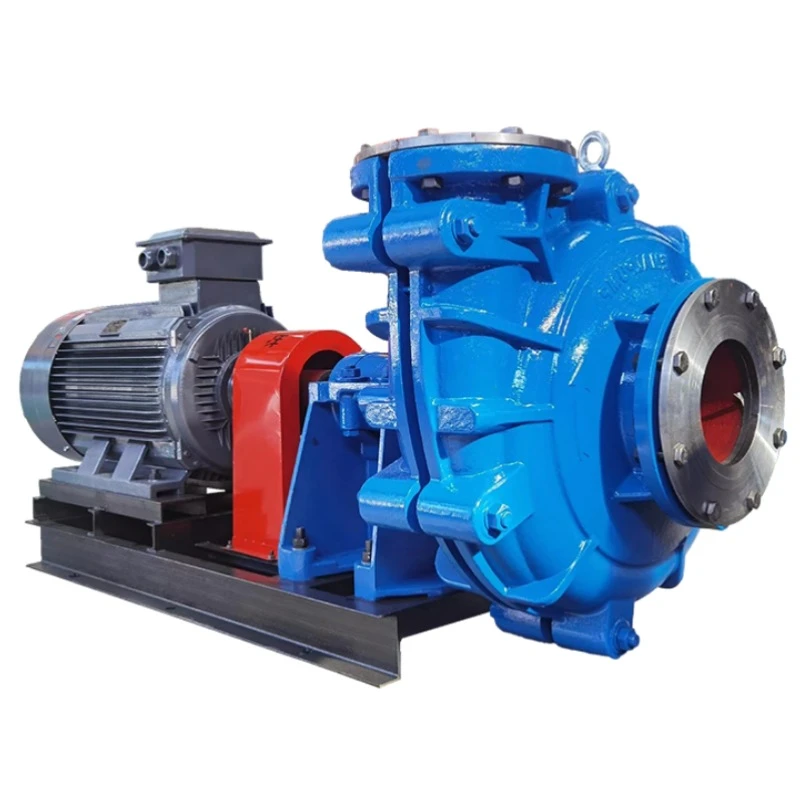
Slurry transfer pumps are critical components in numerous industrial processes, facilitating the movement of abrasive, corrosive, and high-solids-content fluids. These pumps differ significantly from centrifugal pumps designed for clean fluids, demanding specialized construction and engineering to ensure reliability and longevity. Their technical position within the industry chain lies between the process generating the slurry (mining, dredging, wastewater treatment, etc.) and the subsequent processing or disposal stages. Core performance characteristics – flow rate, head pressure, solids handling capability, and abrasion resistance – dictate the pump’s suitability for a given application. A primary industry pain point revolves around premature pump failure due to abrasive wear, leading to significant downtime and maintenance costs. Selection focuses not solely on initial cost, but on total cost of ownership, encompassing lifespan, maintenance frequency, and energy efficiency. This guide provides a detailed technical overview of slurry transfer pumps, encompassing material science, manufacturing processes, performance engineering, failure modes, and relevant industry standards.
Material Science & Manufacturing
Slurry transfer pump construction necessitates materials resistant to both abrasion and corrosion. Common materials include high-chrome cast iron (for abrasive slurries), stainless steel (for corrosive slurries), and specialized alloys like duplex stainless steel or nickel alloys (for highly aggressive environments). The choice hinges on the slurry’s composition, pH, temperature, and particle size distribution. Casting is prevalent for pump housings and impellers, utilizing sand casting, investment casting, or centrifugal casting depending on complexity and required precision. Impellers, particularly, benefit from centrifugal casting to create a layered structure with increased abrasion resistance. Pump shafts are typically forged from alloy steel, heat-treated to achieve optimal tensile strength and fatigue resistance. Seals are crucial; mechanical seals utilizing silicon carbide or tungsten carbide faces are favored for their durability. Manufacturing processes involve stringent quality control measures, including non-destructive testing (NDT) like radiography and ultrasonic testing to detect internal flaws in castings. Weld overlays with hardfacing alloys are frequently employed on pump casings and impellers to enhance abrasion resistance in high-wear areas. Key parameter control during manufacturing includes maintaining precise impeller geometry to optimize hydraulic performance and ensuring proper heat treatment to achieve desired material properties. Liner materials (rubber, polyurethane) are often used within pump casings to provide a sacrificial layer protecting the metal components from abrasive wear. The adhesion between the liner and the metal substrate is critical, achieved through vulcanization or specialized bonding agents.
Performance & Engineering
Slurry pump performance is governed by several key engineering principles. Hydraulic design focuses on maximizing efficiency while minimizing wear. Impeller design – radial, axial, or mixed flow – dictates the pump’s head-capacity characteristics. Radial impellers are suitable for high-head, low-flow applications, while axial impellers are better for low-head, high-flow applications. The pump’s net positive suction head required (NPSHr) must be carefully calculated to prevent cavitation, a phenomenon that can rapidly erode impeller surfaces. Force analysis considers the hydrodynamic forces exerted by the slurry on the impeller and casing, as well as the mechanical stresses induced by pressure and rotation. Environmental resistance is vital; pumps operating outdoors must be protected from extreme temperatures, UV radiation, and moisture. Compliance requirements vary by industry and region. For example, pumps used in mining operations may need to comply with MSHA (Mine Safety and Health Administration) standards. In wastewater treatment, pumps must meet EPA (Environmental Protection Agency) regulations regarding effluent discharge. Functional implementation involves careful selection of pump type, size, and materials based on specific application requirements. Variable frequency drives (VFDs) are increasingly used to control pump speed and flow rate, optimizing energy consumption and reducing wear. Proper piping design is also crucial; minimizing bends and using appropriate pipe materials can reduce pressure drop and erosion. Pump curves (head vs. flow rate) and power curves are essential tools for selecting the optimal pump for a given duty cycle.
Technical Specifications
| Parameter | Unit | Typical Range (Centrifugal Slurry Pump) | Typical Range (Positive Displacement Slurry Pump) |
|---|---|---|---|
| Flow Rate | m³/h | 10 - 1000 | 0.1 - 100 |
| Head Pressure | m | 5 - 80 | 2 - 50 |
| Solids Handling Size | mm | Up to 75 | Up to 100 |
| Slurry Concentration (Weight %) | % | Up to 70 | Up to 80 |
| Pump Material (Casing) | - | High Chrome Iron, Stainless Steel | Stainless Steel, Alloy Steel |
| Pump Material (Impeller) | - | High Chrome Iron, Rubber Lined | Stainless Steel, Hardened Alloy |
Failure Mode & Maintenance
Slurry pump failures are typically categorized as abrasive wear, erosive wear, corrosion, and mechanical failure. Abrasive wear, the most common failure mode, occurs due to the impact of solid particles on pump components. Erosive wear results from the combined action of abrasion and high-velocity fluid flow. Corrosion is caused by chemical attack from corrosive slurries. Mechanical failures include bearing failure, seal failure, and shaft breakage. Fatigue cracking can occur in impeller blades due to cyclic loading. Delamination of rubber liners is another frequent issue. Oxidation of metal components can also contribute to failure. Proactive maintenance is crucial. This includes regular inspection of pump components, monitoring bearing temperatures and vibrations, and lubricating bearings according to manufacturer’s recommendations. Seal replacement is typically performed on a scheduled basis. Impeller and casing replacement is necessary when wear exceeds acceptable limits. Proper pump alignment is essential to prevent bearing failure and seal leakage. Regular cleaning of pump casings and strainers prevents clogging and reduces wear. Failure analysis techniques, such as metallography and wear particle analysis, can help identify the root cause of failures and prevent recurrence. Utilizing wear-resistant coatings and implementing optimized pump operating parameters (flow rate, head pressure) can significantly extend pump lifespan.
Industry FAQ
Q: What is the optimal impeller material for a slurry containing 80% silica sand by weight?
A: For 80% silica sand, a high-chrome cast iron impeller is generally the most cost-effective solution. The high chrome content (typically 26-30%) provides excellent abrasion resistance. However, for extremely abrasive applications or where long service life is critical, a rubber-lined impeller may be preferable, albeit at a higher initial cost. The rubber lining acts as a sacrificial layer, protecting the underlying metal from wear.
Q: How does the pump speed affect abrasion rates in a slurry pump?
A: Generally, increasing pump speed increases abrasion rates. Higher speeds lead to higher impact velocities of slurry particles on pump components. However, reducing pump speed also has drawbacks. It can reduce pump capacity and increase the risk of settling in the pipeline. Therefore, an optimal pump speed must be determined based on the specific slurry characteristics and application requirements.
Q: What are the key considerations when selecting a mechanical seal for a corrosive slurry?
A: Material compatibility is paramount. Seal faces should be made from corrosion-resistant materials such as silicon carbide, tungsten carbide, or ceramic. The seal housing and other components should also be constructed from materials resistant to the specific corrosive agents present in the slurry. Additionally, a robust flushing system is essential to remove abrasive particles and prevent seal failure.
Q: What are the benefits of using a variable frequency drive (VFD) with a slurry pump?
A: VFDs offer several benefits, including energy savings, reduced wear, and improved process control. By adjusting the pump speed, VFDs can match the pump’s output to the actual demand, reducing energy consumption. Lowering the pump speed also reduces abrasion rates and extends pump lifespan. Furthermore, VFDs enable precise control of flow rate and pressure, optimizing process performance.
Q: What is the role of NPSH in slurry pump operation and how is it managed?
A: Net Positive Suction Head (NPSH) is the absolute pressure at the pump suction, minus the vapor pressure of the liquid. Insufficient NPSH can lead to cavitation, causing significant damage to the impeller. Managing NPSH involves ensuring sufficient static head, minimizing suction line losses, and elevating the pump if necessary. Calculating and verifying the available NPSH against the pump's NPSHr is critical during pump selection and installation.
Conclusion
Slurry transfer pumps represent a complex engineering challenge, requiring careful consideration of material science, hydraulic design, and operational parameters. The selection process extends beyond simply matching flow rate and head; it necessitates a deep understanding of the slurry’s characteristics, potential failure modes, and the impact of operating conditions on pump lifespan. Prioritizing abrasion resistance, corrosion resistance, and proper maintenance practices are vital to minimize downtime and maximize return on investment.
Future trends in slurry pump technology will likely focus on advanced materials (ceramic composites, superalloys), improved impeller designs (optimized for solids handling), and smart pump systems (incorporating sensors and predictive maintenance algorithms). The integration of digital technologies will enable real-time monitoring of pump performance, early detection of potential failures, and optimized maintenance scheduling. Continued research and development are essential to address the evolving demands of industries relying on efficient and reliable slurry transfer.
-
Comprehensive Guide to Waterproof ORings for Optimal Sealing Solutions
News2026-06-09
-
Septic Pump System Performance Analysis
News2026-06-08
-
pump for septic Material Science
News2026-06-08
-
basement sewer pump Performance Analysis
News2026-06-08
-
submerged pump Performance Engineering
News2026-06-08
-
Septic System Pumps Performance Analysis
News2026-06-08
-
septic system pump Material Science and Manufacturing
News2026-06-07
-
pump for septic tank Material Science Manufacturing
News2026-06-07
-
submersible sewage pump Material Science
News2026-06-07
-
Sewage Ejector Material Science and Manufacturing
News2026-06-07
-
Ejection Pump Material Science
News2026-06-07
-
pump submersible Performance Analysis
News2026-06-06
-
ejector pumps Performance Engineering
News2026-06-06
-
basement ejector pump Material Science Manufacturing
News2026-06-06
-
Septic Tanks Pumping Performance Analysis
News2026-06-06




