English
- Afrikaans
- Albanian
- Amharic
- Arabic
- Armenian
- Azerbaijani
- Basque
- Belarusian
- Bengali
- Bosnian
- Bulgarian
- Catalan
- Cebuano
- Corsican
- Croatian
- Czech
- Danish
- Dutch
- English
- Esperanto
- Estonian
- Finnish
- French
- Frisian
- Galician
- Georgian
- German
- Greek
- Gujarati
- Haitian Creole
- hausa
- hawaiian
- Hebrew
- Hindi
- Miao
- Hungarian
- Icelandic
- igbo
- Indonesian
- irish
- Italian
- Japanese
- Javanese
- Kannada
- kazakh
- Khmer
- Rwandese
- Korean
- Kurdish
- Kyrgyz
- Lao
- Latin
- Latvian
- Lithuanian
- Luxembourgish
- Macedonian
- Malgashi
- Malay
- Malayalam
- Maltese
- Maori
- Marathi
- Mongolian
- Myanmar
- Nepali
- Norwegian
- Norwegian
- Occitan
- Pashto
- Persian
- Polish
- Portuguese
- Punjabi
- Romanian
- Russian
- Samoan
- Scottish Gaelic
- Serbian
- Sesotho
- Shona
- Sindhi
- Sinhala
- Slovak
- Slovenian
- Somali
- Spanish
- Sundanese
- Swahili
- Swedish
- Tagalog
- Tajik
- Tamil
- Tatar
- Telugu
- Thai
- Turkish
- Turkmen
- Ukrainian
- Urdu
- Uighur
- Uzbek
- Vietnamese
- Welsh
- Bantu
- Yiddish
- Yoruba
- Zulu

Telephone: +86 13120555503
Email: frank@cypump.com


Apr . 01, 2024 17:55 Back to list
Centrifugal Slurry Pump Manufacturers Manufacturing Specifications and Performance Analysis
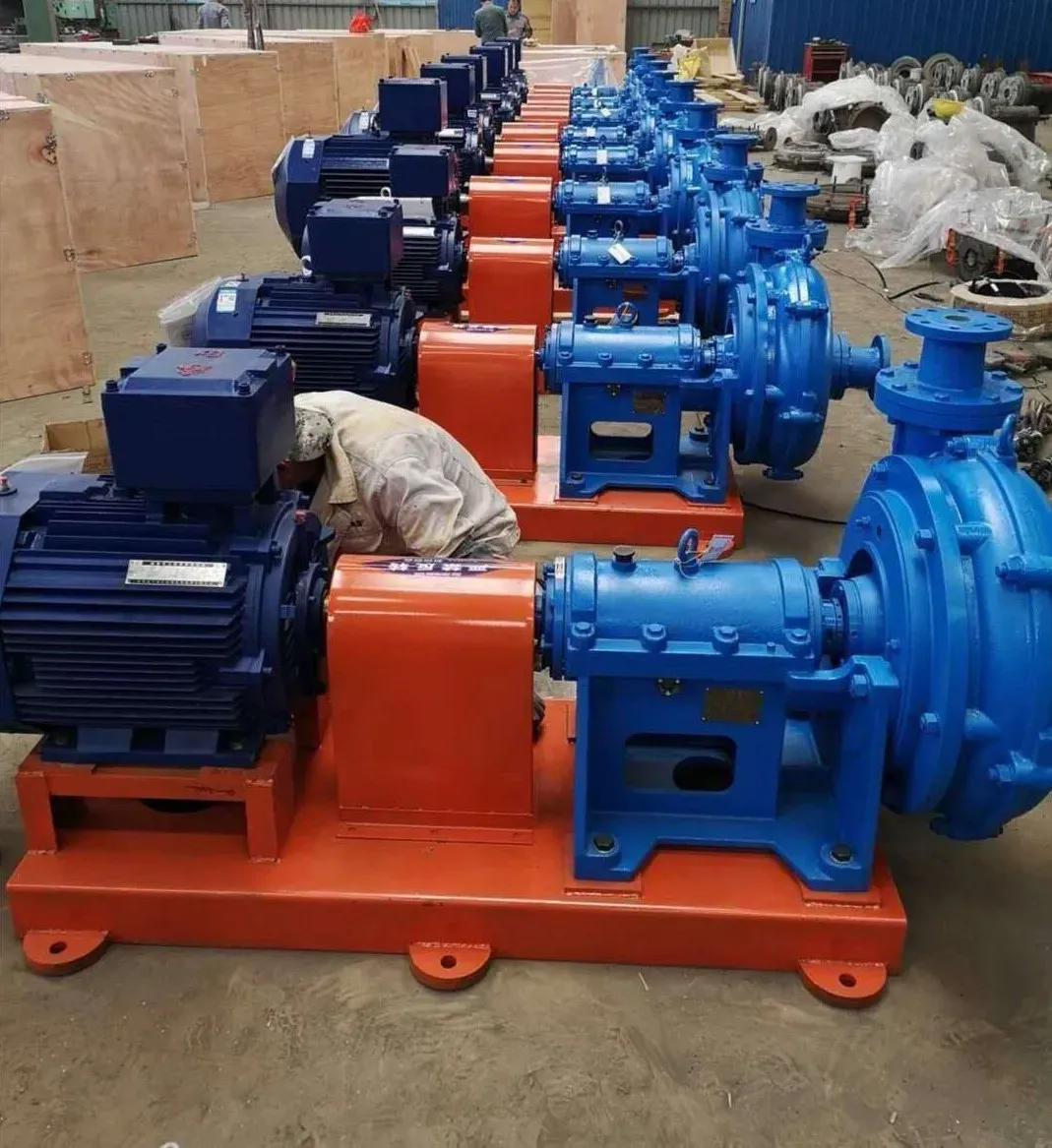
Centrifugal Slurry Pump Manufacturing Specifications and Performance Analysis
Introduction
Centrifugal slurry pumps represent a critical engineering intersection between fluid dynamics and abrasive material science. Specifically designed to transport non-Newtonian fluids containing suspended solid particles—ranging from mine tailings and mineral slurries to chemical waste—these pumps occupy a pivotal position in the industrial chain of mining, dredging, and chemical processing. Unlike standard water pumps, centrifugal slurry pumps must contend with the simultaneous challenges of high-velocity erosive wear and corrosive chemical attack. The technical objective for centrifugal slurry pump manufacturers is to optimize the trade-off between volumetric efficiency and component longevity. This involves precise control over impeller geometry, the application of advanced metallurgy, and the implementation of robust sealing mechanisms to ensure operational stability under extreme hydraulic loads.
Material Science & Manufacturing
The operational lifespan of a slurry pump is fundamentally determined by the material integrity of its wetted parts. Centrifugal slurry pump manufacturers utilize a sophisticated hierarchy of materials based on the specific gravity and abrasiveness of the slurry. For high-chrome applications, ASTM A532 high-chromium white cast irons (containing 20% to 30% Cr) are standard, creating a hard martensitic matrix with embedded M7C3 carbides that resist micro-plowing and abrasive scratching.
In environments where chemical corrosion accompanies abrasion, duplex stainless steels or specialized rubber linings are employed. Natural rubber linings provide exceptional resilience against fine-particle abrasion by absorbing the kinetic energy of the impact, whereas high-alumina ceramics (Al2O3) are utilized for extreme wear zones. The manufacturing process involves complex investment casting or centrifugal casting to ensure a dense, non-porous microstructure, reducing the risk of interstitial corrosion.
Precision machining of the impeller is the most critical manufacturing stage. Using 5-axis CNC milling, manufacturers optimize the vane profile to minimize turbulence and local high-velocity zones (eddies), which are primary sites for accelerated erosion. Furthermore, the balance of the rotating assembly is performed to ISO 1940 G2.5 standards to prevent vibration-induced fatigue in the bearings and shaft assembly.
Performance & Engineering
Engineering a slurry pump requires a rigorous force analysis of the hydraulic load and the impact of solid particles on the pump casing. A primary engineering challenge is the management of the "Critical Settling Velocity." If the flow velocity drops below a specific threshold, suspended solids precipitate, leading to blockage and localized cavitation. Centrifugal slurry pump manufacturers employ Computational Fluid Dynamics (CFD) to ensure that the flow profile remains laminar where possible and that the transition to turbulence does not create erosive hotspots.
The Net Positive Suction Head (NPSH) requirement is significantly higher for slurries than for clear liquids due to the increased viscosity and the presence of solids. Engineering solutions include the use of oversized suction nozzles and the implementation of Variable Frequency Drives (VFDs) to modulate the flow rate according to the slurry density. Furthermore, the integration of an expeller (booster impeller) is often required to increase the NPSH available, preventing cavitation which can lead to catastrophic pitting of the impeller surface.
Sealing engineering focuses on the prevention of slurry ingress into the bearing housing. The transition from traditional gland packing to mechanical seals with external flushing systems (API Plan 32 or 54) has significantly reduced downtime by maintaining a pressure barrier between the pump chamber and the atmosphere.
Technical Specifications
| Parameter Dimension | High-Chrome Alloy Grade | Natural Rubber Lined | Duplex Stainless Steel | Ceramic Composite |
|---|---|---|---|---|
| Hardness (HRC/Shore A) | 60 - 65 HRC | 65 - 75 Shore A | 25 - 35 HRC | > 90 HRC |
| Abrasive Resistance | Excellent (Coarse) | Excellent (Fine) | Moderate | Extreme |
| Corrosion Resistance | Moderate | High (Acidic) | Excellent (Chloride) | Inert |
| Max Particle Size (mm) | Up to 15mm | Up to 8mm | Up to 10mm | Up to 5mm |
| Operating Temp Range | -20°C to 250°C | -10°C to 70°C | -40°C to 200°C | -50°C to 400°C |
| Typical Wear Life | 12 - 24 Months | 8 - 18 Months | 18 - 30 Months | 36+ Months |
Failure Mode & Maintenance
The most prevalent failure mode in centrifugal slurry pumps is Erosive Wear, specifically characterized by "thinning" of the volute casing and "vane receding" in the impeller. This occurs when high-velocity particles strike the surface at oblique angles, removing material through micro-cutting. Another critical failure is Cavitation Erosion, where vapor bubbles collapse violently against the metal surface, creating pits that accelerate general corrosion.
Mechanical failure often manifests as Shaft Deflection or Fatigue Cracking, typically caused by an unbalanced impeller or the operation of the pump too far from its Best Efficiency Point (BEP). Delamination of rubber linings is also a frequent issue, usually triggered by thermal expansion mismatches or chemical degradation of the bonding agent.
Professional maintenance protocols demand a scheduled "Wear Measurement Cycle." Using ultrasonic thickness gauges, technicians must monitor the wall thickness of the volute. When the thickness reaches a predefined safety limit (typically 20% above the minimum wall thickness), a liner replacement is mandatory. For the rotating assembly, dynamic balancing must be re-verified after every impeller rebuild to prevent premature bearing failure.
Industry FAQ
Q: How do you determine the optimal material selection between high-chrome alloy and rubber lining?
A: The decision is based on the particle size and concentration. High-chrome alloys are superior for coarse, large-particle slurries that would puncture rubber. Conversely, rubber linings are more effective for fine-particle slurries, as the elastic deformation of the rubber allows it to "bounce back" from the impact of small particles.
Q: What is the impact of slurry viscosity on the pump's performance curve?
A: Increased viscosity leads to a reduction in the total head (H) and a decrease in efficiency due to higher friction losses. Centrifugal slurry pump manufacturers apply a viscosity correction factor to the water curve to predict the actual performance of the pump when handling thick slurries.
Q: Why does the pump experience severe vibration despite proper installation?
A: This is often caused by "Slurry Plugging" or uneven solids distribution within the impeller, creating a dynamic imbalance. It can also result from operating the pump at a flow rate significantly below the BEP, which induces hydraulic instability and radial thrust.
Q: How can we prevent premature failure of the mechanical seals in abrasive service?
A: The implementation of an external flush system (API Plan 32) is essential. By injecting clean water into the seal chamber at a pressure higher than the pump's internal pressure, we create a hydraulic barrier that prevents abrasive particles from entering the seal faces.
Q: What is the significance of the "Critical Settling Velocity" in piping design?
A: If the velocity is lower than the critical settling velocity, solids will settle at the bottom of the pipe, increasing the effective friction and eventually causing a total blockage. Engineers must ensure the system design maintains a velocity approximately 20-30% above this critical limit.
Conclusion
The engineering of centrifugal slurry pumps is a complex optimization process that balances hydraulic efficiency with extreme material durability. By integrating advanced metallurgy, such as high-chromium white irons and duplex stainless steels, with precision CFD-driven design, manufacturers can significantly mitigate the effects of erosion and corrosion. The technical success of these systems depends not only on the initial manufacturing quality but also on the rigorous adherence to operational parameters and predictive maintenance schedules.
Looking forward, the industry is shifting toward "Smart Slurry Management," incorporating IoT sensors for real-time wear monitoring and AI-driven flow optimization. For operators and procurement managers, the focus must remain on the total cost of ownership (TCO) rather than the initial purchase price, ensuring that material specifications are perfectly aligned with the chemical and physical properties of the transported medium.
-
sewage effluent pumps Material Science Manufacturing
News2026-05-27
-
septic tank effluent pump Performance Analysis
News2026-05-27
-
Septic Sewer Pump Performance Analysis
News2026-05-27
-
septic sewage pumps Performance Analysis
News2026-05-27
-
septic sewage pump Material Science and Manufacturing
News2026-05-27
-
residential sewage pumps Material Science and Manufacturing
News2026-05-26
-
residential sewage lift pump Performance Analysis
News2026-05-26
-
high head sump pump Performance and Engineering
News2026-05-26
-
effluent pump for septic tank Material Science Manufacturing
News2026-05-26
-
effluent and sewage pumps Material Science Manufacturing
News2026-05-26
-
1 2 hp sewage ejector pump Performance Engineering
News2026-05-25
-
Zoeller 1/2 hp sewage pump Performance Analysis
News2026-05-25
-
Effluent Pump Performance Analysis
News2026-05-25
-
sump pump vs effluent pump Performance Analysis
News2026-05-25
-
sewer pumps residential Performance Analysis
News2026-05-25




