English
- Afrikaans
- Albanian
- Amharic
- Arabic
- Armenian
- Azerbaijani
- Basque
- Belarusian
- Bengali
- Bosnian
- Bulgarian
- Catalan
- Cebuano
- Corsican
- Croatian
- Czech
- Danish
- Dutch
- English
- Esperanto
- Estonian
- Finnish
- French
- Frisian
- Galician
- Georgian
- German
- Greek
- Gujarati
- Haitian Creole
- hausa
- hawaiian
- Hebrew
- Hindi
- Miao
- Hungarian
- Icelandic
- igbo
- Indonesian
- irish
- Italian
- Japanese
- Javanese
- Kannada
- kazakh
- Khmer
- Rwandese
- Korean
- Kurdish
- Kyrgyz
- Lao
- Latin
- Latvian
- Lithuanian
- Luxembourgish
- Macedonian
- Malgashi
- Malay
- Malayalam
- Maltese
- Maori
- Marathi
- Mongolian
- Myanmar
- Nepali
- Norwegian
- Norwegian
- Occitan
- Pashto
- Persian
- Polish
- Portuguese
- Punjabi
- Romanian
- Russian
- Samoan
- Scottish Gaelic
- Serbian
- Sesotho
- Shona
- Sindhi
- Sinhala
- Slovak
- Slovenian
- Somali
- Spanish
- Sundanese
- Swahili
- Swedish
- Tagalog
- Tajik
- Tamil
- Tatar
- Telugu
- Thai
- Turkish
- Turkmen
- Ukrainian
- Urdu
- Uighur
- Uzbek
- Vietnamese
- Welsh
- Bantu
- Yiddish
- Yoruba
- Zulu

Telephone: +86 13120555503
Email: frank@cypump.com


Apr . 01, 2024 17:55 Back to list
submersible sewage cutter pump factories Performance Analysis
Introduction
Submersible sewage cutter pumps are critical components in wastewater treatment and conveyance systems, employed to efficiently transfer sewage containing solids to higher elevations or longer distances. These pumps differ from conventional sewage pumps through the inclusion of a cutting mechanism, designed to macerate or shred solid materials present in the sewage stream, preventing clogging and maintaining flow efficiency. Their technical position within the industry chain involves raw material sourcing (cast iron, stainless steel, elastomers), component manufacturing (impellers, cutters, motors, seals), assembly, and final system integration within municipal or industrial wastewater facilities. Core performance characteristics hinge on hydraulic efficiency, cutting capability (particle size reduction), motor power, and operational reliability in abrasive and corrosive environments. A significant pain point in this industry revolves around pump failure due to abrasive wear, impeller blockage, and seal degradation, directly impacting operational costs and necessitating frequent maintenance interventions. Optimized design and material selection are crucial to mitigate these issues.
Material Science & Manufacturing
The construction of submersible sewage cutter pumps relies heavily on specific material properties to withstand the harsh operating conditions. Pump casings are typically manufactured from grey cast iron (ASTM A48 Class 30) due to its excellent abrasion resistance and cost-effectiveness. However, for highly corrosive environments, ductile iron (ASTM A536 85-55-05) or stainless steel (304, 316 – ASTM A240) are utilized, providing superior chemical resistance. Impellers and cutters are commonly made from high-chromium cast iron (ASTM A532 Type III) or hardened stainless steel (440C – ASTM A276) to maximize wear resistance against abrasive solids. Seals are a critical component, with silicon carbide (SiC) or tungsten carbide (WC) mechanical seals favored for their hardness and resistance to chemical attack. Elastomeric components, such as O-rings and diaphragms, are typically composed of nitrile rubber (NBR) or Viton (FKM) to ensure chemical compatibility with sewage constituents. Manufacturing processes include sand casting for the pump housing, investment casting or machining for impellers and cutters, and precision machining for shaft and seal assemblies. Welding processes (SMAW, GTAW) are employed for fabricating structural components. Critical parameter control focuses on maintaining dimensional accuracy during machining, proper heat treatment for hardening components, and rigorous quality control of seal materials to prevent premature failure. Fiber reinforcement polymers are increasingly being explored for non-metallic components to reduce weight and improve corrosion resistance.
Performance & Engineering
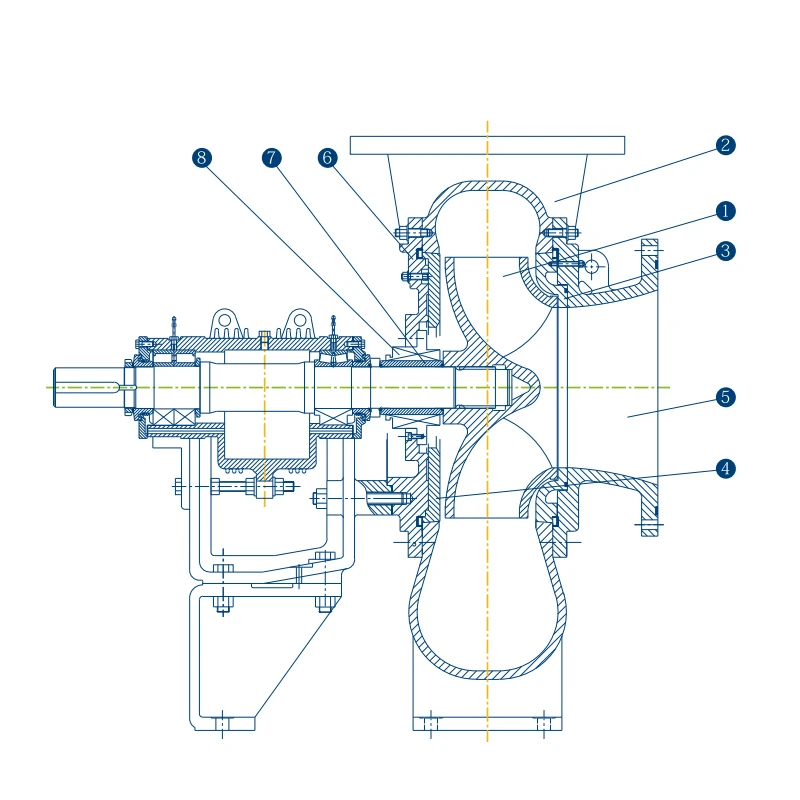
Performance evaluation of submersible sewage cutter pumps involves thorough hydraulic and mechanical analysis. Force analysis considers the radial and axial loads imposed on the impeller and shaft due to fluid flow and solid impact. Finite Element Analysis (FEA) is routinely employed to optimize pump casing design and minimize stress concentrations. Hydraulic efficiency is assessed by measuring pump head, flow rate, and power consumption under varying operating conditions, adhering to standards like ISO 9906. The cutting mechanism’s performance is evaluated by determining its ability to reduce the particle size of representative solids, preventing blockage in downstream piping. Environmental resistance is a crucial design consideration, specifically focusing on corrosion prevention in sewage environments containing hydrogen sulfide (H2S) and other corrosive compounds. Cathodic protection and specialized coatings (epoxy, polyurethane) are frequently implemented to mitigate corrosion. Compliance requirements include adherence to electrical safety standards (IEC 60335-2-40) for submersible pumps, as well as hydraulic performance standards (ANSI/HI). Furthermore, the pumps must meet regional environmental regulations concerning noise emissions and energy efficiency. The impeller design directly impacts the pump's ability to handle solids; a radial impeller design is generally preferred for high-solids content applications. Proper motor selection is critical, considering the pump’s power requirements and the need for thermal protection.
Technical Specifications
| Parameter | Unit | Typical Value (Small Pump) | Typical Value (Large Pump) |
|---|---|---|---|
| Flow Rate | m³/h | 5 - 20 | 100 - 500 |
| Head | m | 10 - 30 | 50 - 150 |
| Motor Power | kW | 0.75 - 2.2 | 7.5 - 55 |
| Solids Handling Capacity | mm | Up to 25 | Up to 75 |
| Impeller Material | - | High-Chrome Cast Iron | Stainless Steel (304/316) |
| Casing Material | - | Grey Cast Iron | Ductile Iron/Stainless Steel |
Failure Mode & Maintenance
Submersible sewage cutter pumps are susceptible to several failure modes. Fatigue cracking in the impeller and casing can occur due to cyclical loading and stress concentrations, particularly in areas around the cutter mechanism. Abrasive wear, caused by the constant impact of solids, leads to material loss in the impeller, casing, and wear plates, reducing pump efficiency. Seal failure, resulting from abrasion, chemical attack, or improper installation, allows sewage to enter the motor housing, causing electrical failure. Delamination of protective coatings can expose the underlying metal to corrosion. Oxidation of electrical connections can lead to intermittent operation or complete failure. Common maintenance procedures include routine inspection of the impeller and cutter for wear, replacement of worn seals and bearings, cleaning of the pump housing to remove debris, and lubrication of moving parts. Preventative maintenance programs, incorporating regular vibration analysis and oil analysis, can detect early signs of component degradation. Failure Analysis (FA) techniques, such as metallographic examination and fracture surface analysis, are crucial for identifying the root cause of failures and implementing corrective actions. The use of non-destructive testing (NDT) methods like ultrasonic testing can identify internal flaws before they lead to catastrophic failure.
Industry FAQ
Q: What is the optimal impeller material for handling highly abrasive sewage with significant grit content?
A: For highly abrasive sewage, high-chromium cast iron (ASTM A532 Type III) is generally the optimal impeller material. Its high hardness and wear resistance significantly extend impeller life compared to standard cast iron. Alternatively, hardened stainless steel alloys can be employed, but at a higher cost.
Q: How does the design of the cutter mechanism impact pump performance and reliability?
A: The cutter mechanism's design is critical. A well-designed cutter should effectively reduce the particle size of solids without creating excessive turbulence or inducing high radial loads on the impeller. Self-cleaning designs, which prevent solids from accumulating around the cutter, are highly desirable.
Q: What are the key considerations for seal selection in corrosive sewage environments?
A: Seal selection must prioritize chemical compatibility with the sewage constituents, particularly hydrogen sulfide (H2S). Silicon carbide (SiC) or tungsten carbide (WC) mechanical seals are preferred for their excellent corrosion resistance. The seal material should also be resistant to abrasion from solids. Regular seal inspection and replacement are crucial.
Q: What preventative maintenance practices are recommended to extend the lifespan of a submersible sewage cutter pump?
A: Recommended practices include regular inspection of the impeller and cutter for wear, lubrication of bearings, vibration analysis to detect imbalance or misalignment, oil analysis to monitor motor health, and periodic cleaning of the pump housing to remove debris. Implementing a scheduled maintenance program is essential.
Q: How do you address the issue of motor overheating in submersible pumps?
A: Motor overheating can be caused by several factors, including inadequate cooling, high ambient temperatures, or electrical issues. Ensuring proper motor ventilation, maintaining clean pump housing to allow for water flow around the motor, verifying correct electrical connections, and implementing thermal overload protection are essential preventive measures.
Conclusion
Submersible sewage cutter pumps represent a sophisticated engineering solution for reliable wastewater conveyance. Their effective operation relies on a confluence of material science, robust manufacturing processes, and precise performance engineering. Understanding the intricacies of material selection – prioritizing abrasion and corrosion resistance – is paramount to maximizing pump lifespan and minimizing operational costs. Failure mode analysis reveals that preventative maintenance, incorporating regular inspection and component replacement, is crucial for mitigating common issues such as impeller wear, seal failure, and motor overheating.
Future advancements in this field are likely to focus on improving hydraulic efficiency, developing more durable materials, and integrating smart monitoring systems for predictive maintenance. These advancements will contribute to lower energy consumption, reduced downtime, and enhanced reliability of wastewater treatment infrastructure. Continued adherence to relevant international standards will be vital for ensuring the safety and performance of these critical components.
-
Precision at the Pump: How Better Machining Protects Flow and Uptime
News2026-11-20
-
Why Pump Reliability Begins Before the First Drop of Fluid
News2026-11-20
-
Beyond the Pump: Designing Safer Access Around Critical Water Infrastructure
News2026-11-20
-
Why Pumping Stations Depend on the Infrastructure Beneath the Pumps
News2026-11-20
-
Beyond the Pump Room: How Smarter Loading Protects Industrial Equipment
News2026-11-19
-
When Pumps Stop: Designing More Resilient Power for Critical Pumping Systems
News2026-11-19
-
The Hidden Role of Dust and Gas Monitoring in Reliable Pump Operations
News2026-11-19
-
The Hidden Role of Mineral Compounds in Extending Industrial Pump Lifespan
News2026-10-12
-
Why Pump System Reliability Depends on Precision Hose Assembly Methods
News2026-09-15
-
How Advanced Imaging Films Are Transforming Pump Component Quality Control
News2026-08-25
-
How Advanced Filtration Protects Pump Systems from Premature Wear and Costly Downtime
News2026-08-25
-
How Steel Material Selection Drives Pump Reliability in Heavy-Duty Systems
News2026-08-25
-
Ensuring Pump System Efficiency: The Role of High-Quality Pipe Fittings and Tubing
News2026-08-24
-
Optimizing Fluid Dynamics and Material Consistency in Industrial Processing
News2026-08-18
-
Innovations and Challenges in Hydraulic Systems for Heavy Machinery
News2026-08-13




