English
- Afrikaans
- Albanian
- Amharic
- Arabic
- Armenian
- Azerbaijani
- Basque
- Belarusian
- Bengali
- Bosnian
- Bulgarian
- Catalan
- Cebuano
- Corsican
- Croatian
- Czech
- Danish
- Dutch
- English
- Esperanto
- Estonian
- Finnish
- French
- Frisian
- Galician
- Georgian
- German
- Greek
- Gujarati
- Haitian Creole
- hausa
- hawaiian
- Hebrew
- Hindi
- Miao
- Hungarian
- Icelandic
- igbo
- Indonesian
- irish
- Italian
- Japanese
- Javanese
- Kannada
- kazakh
- Khmer
- Rwandese
- Korean
- Kurdish
- Kyrgyz
- Lao
- Latin
- Latvian
- Lithuanian
- Luxembourgish
- Macedonian
- Malgashi
- Malay
- Malayalam
- Maltese
- Maori
- Marathi
- Mongolian
- Myanmar
- Nepali
- Norwegian
- Norwegian
- Occitan
- Pashto
- Persian
- Polish
- Portuguese
- Punjabi
- Romanian
- Russian
- Samoan
- Scottish Gaelic
- Serbian
- Sesotho
- Shona
- Sindhi
- Sinhala
- Slovak
- Slovenian
- Somali
- Spanish
- Sundanese
- Swahili
- Swedish
- Tagalog
- Tajik
- Tamil
- Tatar
- Telugu
- Thai
- Turkish
- Turkmen
- Ukrainian
- Urdu
- Uighur
- Uzbek
- Vietnamese
- Welsh
- Bantu
- Yiddish
- Yoruba
- Zulu

Telephone: +86 13120555503
Email: frank@cypump.com


Apr . 01, 2024 17:55 Back to list
Centrifugal Pump difference between single suction and double suction
Introduction
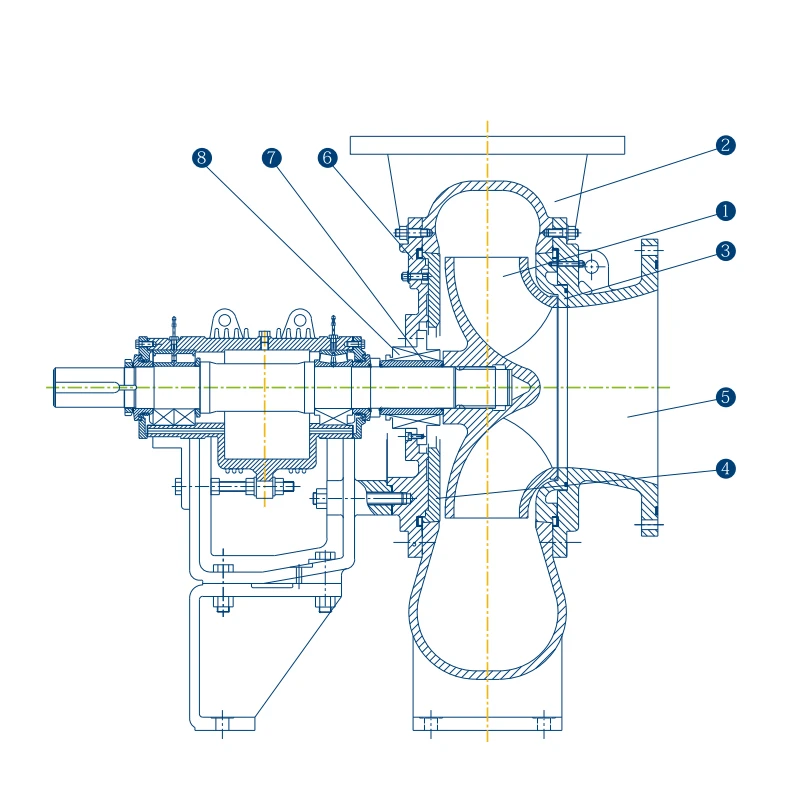
Centrifugal pumps are ubiquitous in industrial applications, and a fundamental classification lies between single-suction and double-suction designs. This technical guide provides an in-depth analysis of these pump types, focusing on their construction, performance characteristics, and suitability for various applications. Single-suction pumps, as the name suggests, draw fluid in from one inlet, while double-suction pumps utilize inlets on opposite sides of the impeller. This seemingly simple difference dictates significant variations in hydraulic performance, efficiency, and application suitability. The selection between these pump types is crucial for system optimization, preventing premature failure, and ensuring efficient fluid transfer. This analysis will delve into the engineering principles governing their operation, common failure modes, and relevant industry standards. Core industry pain points addressed include cavitation risk, Net Positive Suction Head Required (NPSHr) considerations, and balancing radial thrust within the pump assembly. Understanding these nuances is paramount for procurement managers, design engineers, and maintenance personnel.
Material Science & Manufacturing
The primary material for pump casings in both single and double-suction pumps is typically cast iron (ASTM A48 Class 30), due to its cost-effectiveness and machinability. However, for corrosive fluids, materials like stainless steel (304, 316 – ASTM A743), duplex stainless steel, or specialized alloys (Hastelloy) are employed. Impellers are commonly manufactured from cast iron, bronze (ASTM B148), or stainless steel, chosen based on fluid properties and abrasion resistance. The manufacturing process for single-suction pumps involves casting the volute casing, machining the impeller, and assembling the components with appropriate seals (typically mechanical seals conforming to API 682). Double-suction pumps require more complex casting procedures to create the symmetrical volute and maintain accurate alignment of the two suction inlets. Key parameter control during manufacturing includes impeller balancing (achieving dynamic balance to minimize vibration – ISO 1940-1), volute surface finish (to reduce friction losses), and dimensional accuracy of the impeller-casing clearances (influencing leakage and efficiency). Welding processes, when used for repairs or customized constructions, must adhere to AWS D1.1 standards to ensure structural integrity. The chemical compatibility of the pump materials with the pumped fluid is critical; for example, exposure to chlorides can induce pitting corrosion in stainless steels if the alloy is not appropriately selected. Finite Element Analysis (FEA) is routinely used in the design phase to optimize casing geometry and minimize stress concentrations, particularly around the suction and discharge nozzles.
Performance & Engineering
The performance of both pump types is governed by the affinity laws, relating flow rate, head, and power consumption to impeller speed. However, double-suction pumps offer distinct advantages in specific scenarios. Due to the larger suction area, double-suction pumps typically exhibit a lower Net Positive Suction Head Required (NPSHr) compared to single-suction pumps of the same capacity. This reduces the risk of cavitation, especially when dealing with fluids prone to vapor lock or operating at higher elevations. Force analysis reveals that single-suction pumps generate radial thrust due to the asymmetric flow into the impeller. This thrust is counteracted by bearing design and potentially by utilizing balancing devices. Double-suction pumps, with their symmetrical flow, inherently minimize radial thrust, resulting in extended bearing life and reduced vibration. Environmental resistance is largely dictated by the material selection. Pumps operating in corrosive environments require specialized coatings (epoxy, PTFE) or the use of corrosion-resistant alloys. Compliance requirements include adherence to hydraulic institute standards (HI) for pump performance testing and efficiency ratings. The pump’s hydraulic power output is calculated using the formula P = (Q H ρ g) / η, where Q is the flow rate, H is the head, ρ is the fluid density, g is the acceleration due to gravity, and η is the pump efficiency. Understanding these parameters is crucial for proper system design and optimization.
Technical Specifications
| Parameter | Single-Suction Pump | Double-Suction Pump | Typical Applications |
|---|---|---|---|
| Flow Rate (m³/hr) | Up to 500 | Up to 2000 | Water supply, HVAC, general industrial pumping |
| Head (m) | Up to 100 | Up to 150 | Boiler feed water, cooling water circulation |
| NPSHr (m) | 1.5 - 5 | 0.8 - 3 | Applications with limited suction head |
| Efficiency (%) | 65 - 80 | 70 - 85 | High-volume fluid transfer |
| Radial Thrust | Significant | Minimal | High-speed applications, long bearing life requirement |
| Casing Material | Cast Iron, Stainless Steel | Cast Iron, Stainless Steel | Fluid compatibility considerations |
Failure Mode & Maintenance
Common failure modes in single-suction pumps include impeller cavitation (leading to erosion and reduced performance), bearing failure (due to radial thrust and inadequate lubrication), and seal leakage (resulting in fluid loss and potential environmental contamination). Double-suction pumps are less susceptible to cavitation due to their lower NPSHr, but can still experience failures related to bearing wear, seal failure, and impeller corrosion. Fatigue cracking can occur in the casing or impeller due to cyclic loading and stress concentrations. Delamination of coatings (if applied) can expose the underlying metal to corrosion. Oxidation of impeller materials can reduce efficiency and increase wear. Preventative maintenance is crucial. This includes regular vibration analysis (ISO 10816), oil analysis of bearings, seal inspection and replacement, and impeller balancing. For cavitation damage, reducing pump speed or increasing suction pressure is recommended. Bearing failures often require complete bearing replacement and potentially impeller realignment. Seal leakage necessitates seal replacement and investigation into the root cause (e.g., misalignment, abrasive particles). Regular inspection for corrosion and timely repair or replacement of affected components are vital for extending pump lifespan. Detailed maintenance logs, adhering to ISO 55000 standards for asset management, are essential for tracking maintenance activities and identifying recurring issues.
Industry FAQ
Q: What are the primary advantages of a double-suction pump over a single-suction pump for a large-volume water intake application?
A: The primary advantage lies in the reduced NPSHr, minimizing the risk of cavitation, especially in applications where the water source has a limited elevation head or experiences fluctuations in water level. The symmetrical design also results in significantly lower radial thrust, extending bearing life and reducing vibration. The higher flow rate capacity is also a key benefit for large intake systems.
Q: How does material selection influence the longevity of a pump handling a corrosive fluid like sulfuric acid?
A: Material selection is paramount. Standard cast iron will rapidly corrode in sulfuric acid. Options include specialized alloys like Hastelloy, duplex stainless steels, or the use of rubber or PTFE linings. The concentration and temperature of the acid must be considered, as these factors significantly impact corrosion rates. Regular inspection for pitting corrosion is crucial.
Q: What are the implications of operating a pump outside of its recommended flow rate range?
A: Operating outside the recommended range can lead to several issues. Flow rates significantly below the design point can result in increased recirculation and reduced efficiency. Flow rates significantly above the design point can lead to cavitation, increased stress on the impeller, and potential mechanical failure. It's essential to operate within the pump’s performance curve.
Q: What preventative maintenance measures are most effective for minimizing bearing failures in a single-suction pump?
A: Regular oil analysis to monitor lubricant condition and detect wear particles, vibration analysis to identify imbalances or misalignment, and proper lubrication practices are crucial. Ensuring adequate bearing cooling and protecting the bearings from ingress of contaminants are also essential preventative measures. Adhering to manufacturer’s recommendations for bearing type and lubrication intervals is vital.
Q: How can I determine if a pump is experiencing cavitation, and what steps should I take to address it?
A: Common indicators of cavitation include a rattling or knocking noise, reduced pump performance, and erosion of the impeller. Checking the NPSHa (Net Positive Suction Head Available) and comparing it to the NPSHr (Net Positive Suction Head Required) is the first step. If NPSHa is less than NPSHr, increasing suction pressure, reducing pump speed, or lowering the fluid temperature are potential solutions. Addressing obstructions in the suction line is also critical.
Conclusion
The selection between single-suction and double-suction centrifugal pumps is a critical engineering decision impacting system performance, reliability, and lifecycle cost. Single-suction pumps offer a cost-effective solution for lower-flow, lower-head applications, while double-suction pumps excel in scenarios demanding high flow rates, low NPSHr, and minimized radial thrust. Thorough consideration of fluid properties, system requirements, and potential failure modes is essential for making an informed decision.
Continued advancements in pump design and materials science are focused on enhancing efficiency, reducing energy consumption, and improving resistance to corrosion and wear. Implementing proactive maintenance strategies, adhering to industry standards, and leveraging data-driven insights will further optimize pump performance and extend operational lifespan. The trend towards digitalization and predictive maintenance will play an increasingly important role in ensuring reliable and efficient pump operation.
-
basement bathroom sewage pump Material Science Manufacturing
News2026-05-21
-
wastewater treatment plant pumps Material Science Manufacturing
News2026-05-21
-
waste water pump for basement Material Science Manufacturing
News2026-05-21
-
sump pump sewage Performance Analysis
News2026-05-21
-
sump pump for sewage Material Science and Manufacturing
News2026-05-21
-
sump pump for septic systems Material Science Manufacturing
News2026-05-20
-
sump pump and ejector pump Material Science Manufacturing
News2026-05-20
-
sewage treatment plant pumps Performance Analysis
News2026-05-20
-
sewage tank pump Material Science and Manufacturing
News2026-05-20
-
sewage pump for septic tank Performance Analysis
News2026-05-20
-
Sewage Pump and Tank Performance Analysis
News2026-05-19
-
Sewage Ejector Pump Replacement Performance Analysis
News2026-05-19
-
sewage ejector pump for basement bathroom Material Science Manufacturing
News2026-05-19
-
sewage ejection pump Material Science and Manufacturing
News2026-05-19
-
in line sewage pump Performance Analysis
News2026-05-19




