English
- Afrikaans
- Albanian
- Amharic
- Arabic
- Armenian
- Azerbaijani
- Basque
- Belarusian
- Bengali
- Bosnian
- Bulgarian
- Catalan
- Cebuano
- Corsican
- Croatian
- Czech
- Danish
- Dutch
- English
- Esperanto
- Estonian
- Finnish
- French
- Frisian
- Galician
- Georgian
- German
- Greek
- Gujarati
- Haitian Creole
- hausa
- hawaiian
- Hebrew
- Hindi
- Miao
- Hungarian
- Icelandic
- igbo
- Indonesian
- irish
- Italian
- Japanese
- Javanese
- Kannada
- kazakh
- Khmer
- Rwandese
- Korean
- Kurdish
- Kyrgyz
- Lao
- Latin
- Latvian
- Lithuanian
- Luxembourgish
- Macedonian
- Malgashi
- Malay
- Malayalam
- Maltese
- Maori
- Marathi
- Mongolian
- Myanmar
- Nepali
- Norwegian
- Norwegian
- Occitan
- Pashto
- Persian
- Polish
- Portuguese
- Punjabi
- Romanian
- Russian
- Samoan
- Scottish Gaelic
- Serbian
- Sesotho
- Shona
- Sindhi
- Sinhala
- Slovak
- Slovenian
- Somali
- Spanish
- Sundanese
- Swahili
- Swedish
- Tagalog
- Tajik
- Tamil
- Tatar
- Telugu
- Thai
- Turkish
- Turkmen
- Ukrainian
- Urdu
- Uighur
- Uzbek
- Vietnamese
- Welsh
- Bantu
- Yiddish
- Yoruba
- Zulu

Telephone: +86 13120555503
Email: frank@cypump.com


Apr . 01, 2024 17:55 Back to list
best double suction fire pump Performance Engineering
Introduction
Double suction fire pumps are centrifugal pumps specifically engineered for the reliable and high-volume delivery of water in fire protection systems. Unlike single-suction pumps which draw water from one side of the impeller, these pumps feature inlets on both sides, significantly increasing flow rates and reducing axial thrust. Their position within the fire protection chain is critical; they are typically located in a dedicated fire pump room, drawing water from a source – a water tank, fire reservoir, or the municipal water supply – and delivering pressurized water to a network of sprinklers, standpipes, and hose streams. Core performance is characterized by flow rate (GPM), head (feet), and adherence to stringent national and international fire protection standards (NFPA 20 being paramount). The double suction design minimizes hydraulic loss, improving efficiency and reducing the required motor horsepower for a given application. A key industry pain point is ensuring consistent performance under varying water supply conditions and maintaining pump reliability through regular inspection and maintenance to prevent critical system failure during an emergency.
Material Science & Manufacturing
The core components of a double suction fire pump necessitate specific material selection and manufacturing processes to withstand high pressures, corrosive environments, and continuous operation. The pump casing is frequently constructed from cast iron (ASTM A126 Class B) due to its affordability, machinability, and inherent strength. However, for seawater or corrosive water sources, bronze (specifically, bronze alloys like C83600) or stainless steel (316/316L) are employed for superior corrosion resistance. Impellers are generally manufactured from cast iron, bronze, or stainless steel, often utilizing a closed impeller design for higher efficiency or an open impeller design for handling fluids with solids. Shaft materials are typically alloy steel (4140 or 4340) heat-treated to achieve high tensile strength and fatigue resistance. Seals are critical; mechanical seals incorporating silicon carbide faces are standard for long life and minimal leakage. Manufacturing involves precision casting of the casing and impeller, followed by rigorous machining to ensure dimensional accuracy and smooth hydraulic surfaces. Welding, where required (e.g., for certain piping connections), is performed using shielded metal arc welding (SMAW) or gas tungsten arc welding (GTAW) processes, adhering to AWS D1.1 standards. Parameter control during casting (cooling rates, mold material) and machining (tolerance levels, surface finish) are crucial to prevent stress concentrations and ensure hydraulic performance. Post-manufacturing, hydrostatic testing to 1.5 times the working pressure is mandatory to verify casing integrity.
Performance & Engineering
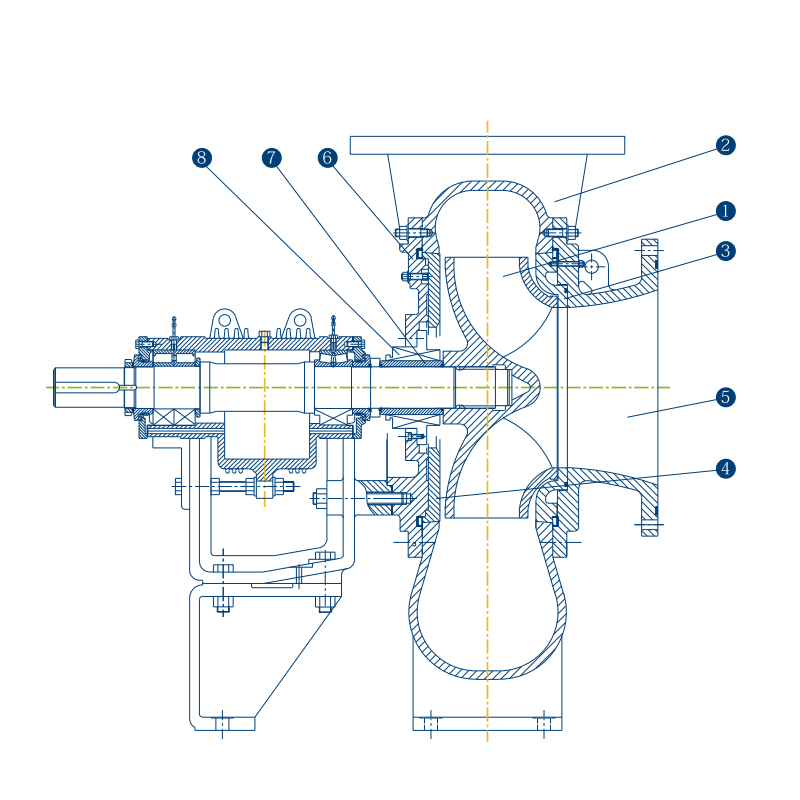
Performance evaluation of a double suction fire pump revolves around its hydraulic characteristics and adherence to NFPA 20 standards. Force analysis centers on managing radial and axial thrust generated by the impeller. The double suction configuration significantly reduces axial thrust compared to single-suction pumps, minimizing bearing loads and extending pump life. Hydraulic Institute standards dictate pump curves detailing flow rate, head, and efficiency across the operating range. Environmental resistance is paramount; pumps must operate reliably in temperatures ranging from freezing to high ambient conditions. Shaft alignment is critical to prevent vibration and bearing failure – laser alignment techniques are routinely employed. Compliance requirements extend beyond NFPA 20 to include Underwriters Laboratories (UL) listing and Factory Mutual (FM) approval, demonstrating adherence to safety and performance criteria. Functional implementation necessitates careful system design, including proper pipe sizing to minimize friction losses and ensure adequate water velocity. The Net Positive Suction Head Required (NPSHr) – a characteristic of the pump – must be less than the Net Positive Suction Head Available (NPSHa) in the system to prevent cavitation, a phenomenon that causes impeller damage and performance degradation. Pump selection must account for anticipated system demand, elevation changes, and friction losses to ensure the pump can deliver the required flow and pressure at the highest point in the system.
Technical Specifications
| Parameter | Typical Range (Units) | Material Specification | NFPA 20 Compliance |
|---|---|---|---|
| Flow Rate | 250 - 2500 GPM | Hydraulic Performance Curve | Mandatory |
| Head | 80 - 300 ft | System Curve Analysis | Mandatory |
| Motor Horsepower | 25 - 200 HP | NEMA MG 1 | Mandatory |
| Casing Material | Cast Iron (A126 Class B), Bronze (C83600), Stainless Steel (316/316L) | ASTM Standards | Material Compatibility Required |
| Impeller Material | Cast Iron, Bronze, Stainless Steel | ASTM Standards | Hydrostatic Testing |
| Seal Type | Mechanical Seal (Silicon Carbide Faces) | API 682 | Leakage Prevention |
Failure Mode & Maintenance
Failure modes in double suction fire pumps are diverse, demanding proactive maintenance. Fatigue cracking in the impeller, particularly around the vanes, can occur due to cyclical loading and cavitation. Delamination of the casing coating (if applicable) leads to corrosion. Bearing failure, manifested as increased vibration and noise, often results from improper lubrication, misalignment, or excessive loading. Mechanical seal failure results in leakage and potentially catastrophic pump damage. Corrosion, especially in pumps handling seawater or corrosive fluids, weakens the casing and impeller. Oxidation of metallic components, even in seemingly benign environments, can gradually degrade material properties. Preventative maintenance should include regular vibration analysis, bearing lubrication (following manufacturer’s recommendations), seal inspection and replacement, and casing coating repair. Hydrostatic testing should be performed annually. Impeller inspection (visual and non-destructive testing) is crucial to detect cracks. Periodic flushing of the pump and piping system removes sediment and debris. Detailed record-keeping of maintenance activities is essential for tracking pump performance and identifying potential problems before they escalate. A comprehensive pump performance test, including flow rate and head measurements, should be conducted during periodic inspections to verify continued compliance with NFPA 20 standards.
Industry FAQ
Q: What is the impact of NPSHa on pump performance and longevity?
A: Insufficient NPSHa (Net Positive Suction Head Available) is a critical issue. If NPSHa is less than NPSHr (Net Positive Suction Head Required), cavitation occurs. Cavitation causes vapor bubbles to form and collapse within the impeller, leading to erosion, noise, reduced pump efficiency, and ultimately, impeller damage. Maintaining adequate NPSHa is achieved through proper system design – minimizing suction lift, increasing tank elevation, or reducing pipe friction losses on the suction side of the pump.
Q: How does impeller trim affect pump performance and efficiency?
A: Impeller trim – reducing the impeller diameter – is a common method for adjusting pump performance to match system requirements. However, trimming the impeller reduces pump efficiency. While it lowers the flow rate and head, it also increases the hydraulic losses within the pump. The optimal trim amount should be determined through careful hydraulic analysis to balance performance adjustments with efficiency considerations.
Q: What are the considerations for selecting a driver (motor) for a double suction fire pump?
A: The driver must be sized to provide sufficient horsepower to meet the pump’s required flow and head at all operating conditions, with a safety factor. The motor must be compliant with NEMA MG 1 standards and suitable for the environment (e.g., explosion-proof for hazardous locations). Consider the motor’s efficiency, starting torque, and voltage requirements. A variable frequency drive (VFD) may be used to control pump speed and optimize energy consumption.
Q: What is the role of the jockey pump in a fire pump system?
A: The jockey pump is a small pump that maintains system pressure in the fire protection piping. Its purpose is to compensate for minor leaks and pressure fluctuations, preventing the main fire pump from cycling on and off unnecessarily. Frequent cycling can shorten the life of the main pump. The jockey pump operates automatically to maintain a predetermined pressure setpoint.
Q: How often should a double suction fire pump be subjected to a full flow test?
A: A full flow test, in accordance with NFPA 25, should be conducted annually. This test verifies that the pump can deliver the required flow and pressure at the specified head. The test should include measuring flow rate, pressure, and motor current. Any discrepancies should be investigated and addressed promptly.
Conclusion
Double suction fire pumps represent a critical component in comprehensive fire protection systems. Their superior hydraulic performance, stemming from the double-suction impeller design, enables efficient and reliable delivery of large water volumes required to suppress fires. Proper material selection, precise manufacturing processes, and diligent adherence to industry standards – notably NFPA 20 – are essential for ensuring long-term performance and reliability.
Effective maintenance, encompassing regular inspections, preventative measures, and comprehensive testing, is paramount to mitigate common failure modes such as cavitation, corrosion, and bearing failure. A proactive approach to maintenance, combined with a thorough understanding of system hydraulics and pump characteristics, guarantees the dependable operation of these life-safety devices when they are needed most.
-
Comprehensive Guide to Waterproof ORings for Optimal Sealing Solutions
News2026-06-09
-
Septic Pump System Performance Analysis
News2026-06-08
-
pump for septic Material Science
News2026-06-08
-
basement sewer pump Performance Analysis
News2026-06-08
-
submerged pump Performance Engineering
News2026-06-08
-
Septic System Pumps Performance Analysis
News2026-06-08
-
septic system pump Material Science and Manufacturing
News2026-06-07
-
pump for septic tank Material Science Manufacturing
News2026-06-07
-
submersible sewage pump Material Science
News2026-06-07
-
Sewage Ejector Material Science and Manufacturing
News2026-06-07
-
Ejection Pump Material Science
News2026-06-07
-
pump submersible Performance Analysis
News2026-06-06
-
ejector pumps Performance Engineering
News2026-06-06
-
basement ejector pump Material Science Manufacturing
News2026-06-06
-
Septic Tanks Pumping Performance Analysis
News2026-06-06




